
Cicely Leadley-Brown and the Women’s Suffrage Movement
![[D] Photograph of Eleanor Rathbone and other Liverpool suffragists (1910)](https://res.cloudinary.com/lincolnsinn-site/image/upload/w_991,h_591,f_auto,c_fill,g_auto/web-main/2026/03/D-Photograph-of-Eleanor-Rathbone-and-other-Liverpool-suffragists-1910-scaled-e1772732297291.jpg)
When Cicely Leadley-Brown was admitted to the Inn on 18 November 1921, women had only recently been permitted to enter the legal profession. The Sex Disqualification (Removal) Act 1919 had opened the door, but the early women members still had to struggle for recognition and opportunities.


Her admission form records two references: Egerton Stewart-Brown, her second cousin and an Inner Temple barrister, and Eleanor Florence Rathbone, noted as a Justice of the Peace and member of Liverpool City Council, who had known her for upwards of twelve years.

Eleanor Rathbone was a social reformer and suffragist, and Cicely Leadley-Brown worked alongside her on suffrage activities in Liverpool. Her other reference, Egerton Stewart-Brown, was married to Nessie Stewart-Brown, also a suffragist and Liberal Party politician. Nessie also worked with Eleanor Rathbone on suffrage causes in Liverpool. Both women’s names and images appear on the plinth of the statue of Millicent Garrett Fawcett in Parliament Square.
The suffragists, who had emerged in the mid nineteenth century, differed from the suffragettes in that they pursued women’s suffrage through peaceful and constitutional methods. Eleanor Rathbone was a key figure in this campaign. Cicely Leadley-Brown is little known in comparison, but she was an active participant in the movement and had connections with many of the leading women engaged in social reform.
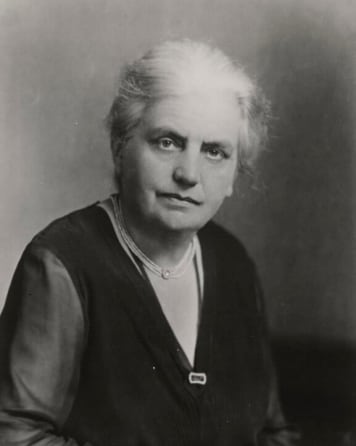
At the time of her admission, she was 39 and living in Dawstone, Heswall, Cheshire, where her father was a land and estate agent. In related correspondence, Cicely Leadley-Brown listed two sureties, one of whom differed from those recorded on her application form: ‘Miss Elizabeth Macadam, 50 Romney Street, Westminster.’

This name and address were significant. Elizabeth Macadam and Eleanor Rathbone were fellow social reformers and lifelong companions. In 1919 they moved from Liverpool to 50 Romney Street, Westminster, after Eleanor Rathbone succeeded Millicent Garrett Fawcett as president of the suffragist organisation the National Union of Societies for Equal Citizenship (NUSEC).
Cicely Leadley-Brown had long been engaged in social causes, including the women’s suffrage movement, before her admission to the Inn in 1921. A photograph dated 1910, held in the University of Liverpool’s collections, shows her seated in her car outside the Liverpool Women’s Suffrage Society shop.

She is pictured in the driving seat with another woman, while other suffragists, including Eleanor Rathbone, stand on the pavement. Sources reveal that Cicely’s motor car was regularly used to support suffragist activities, including during ‘The Great Pilgrimage’ of 1913. During that journey she even demonstrated her hands-on motoring skills, repairing her own car and more surprisingly, one belonging to a group who had come to harangue the suffragists in Oxford.
The Great Pilgrimage of 1913 was a nonviolent march for women’s suffrage in Britain, organised by the National Union of Women’s Suffrage Societies (NUWSS). It lasted about six weeks, and women marched to London from across England and Wales, culminating in a Hyde Park rally attended by 50,000 people on 26 July.
Contemporary accounts of the pilgrimage offer glimpses of her character. A fellow pilgrim, Alice New, described Cicely Leadley-Brown as ‘quick-tempered…and had to be restrained from using fisticuffs.’ Yet she also noted her lighter side, recalling that Cicely was a ‘virtuoso whistler…her whistling was so beautiful it brought tears to the eyes,’ and that she enjoyed cooking for the pilgrims she travelled with. Alice New reflected that “Really, I believe that girl could turn her hand to anything, and she was the life of the party, too!”
Cicely Leadley-Brown was active across a wide range of suffrage work. Before the First World War, she campaigned with the Liverpool Women’s Suffrage Society, including during the Kirkdale by-election, contributed to the Church League for Women’s Suffrage, and delivered public speeches, including one advocating women’s right to vote to over 300 people.
After the outbreak of the First World War, she initiated the Patriotic Housekeeping Exhibition in 1915, a suffragist public engagement initiative that toured Britain. Topics included vegetarian cookery, shoe repairing, child welfare and home front patriotism.
Her admission form records her as an MBE, and the London Gazette confirms that she received this honour in 1918 for her wartime role as Welfare Supervisor at a National Projectile Factory in Dudley.
Cicely Leadley-Brown was Called to the Bar on 2 July 1924, and her signature appears in the Bar Book for that period in the archive. She subsequently practised as a barrister on the Northern Circuit. She shared chambers with her cousin, Egerton Stewart-Brown, at 8 Cook Street, Liverpool.

Newspapers record her representing Arthur Clarke in 1934 under the Guardianship of Infants Act and highlight her dedication to child welfare and adoption. She served as ‘hon. secretary’ of the Liverpool Child Adoption Society in 1930, the Lancashire and Cheshire Child Adoption Council in 1941, and in 1948 wrote to the Liverpool Echo on the importance of anonymous reports of child cruelty, signing as Secretary of LSPCC, 3 Islington Square, Liverpool – the building that had housed the Liverpool Society for the Prevention of Cruelty to Children before it later became part of the NSPCC.
When she left Liverpool in 1958 following her retirement, she told the press that “I practised on the Northern Circuit for eighteen years and retired when my chambers were destroyed in the 1941 blitz.” She conceded that “retirement has its compensations…it gives one time to read the morning paper at leisure.” She described her legal and volunteer work as being “as varied as it has been unremunerative” but confessed that she got the most satisfaction from her time at the Lancashire and Cheshire Child Adoption Council in its first 16 years.
Archival records allow us to rediscover and celebrate figures like Cicely Leadley-Brown, whose contributions were vital to their communities, alongside the broader networks of women driving social and legal reform during a transformative period.