
William Penn, the American Constitution, and International Peace

As the United States marks the 250th anniversary of the Declaration of Independence, attention naturally turns to the Founding Fathers. Yet some of the ideas that shaped American constitutional government can be traced to earlier figures who never signed the Declaration. Among them was William Penn, a member of Lincoln’s Inn.
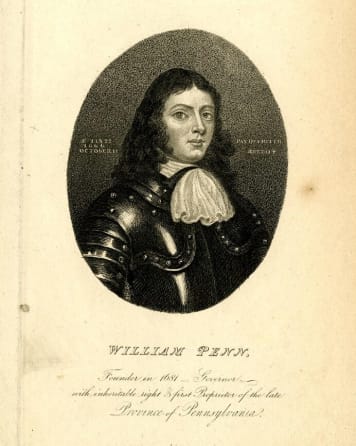
Born in 1644, Penn was the son of Admiral Sir William Penn and was educated at Christ Church, Oxford. After leaving Oxford, he travelled on the Continent before returning to England in 1664. Once in London, he joined Lincoln’s Inn and was admitted on 14 February 1665. His admission entry shows that one of his manucaptors (guarantors) was William Batten, the son of Captain William Batten, a close friend of Penn’s father.

William Penn did not go on to be Called to the Bar and appears to have left the Inn in the spring of 1665. This coincided with the outbreak of plague, which led to the temporary closure of the Inn, making it likely that he was unable to remain there even if he had wished to do so.
Penn’s father had been a Presbyterian before conforming to the Church of England in 1660, while his mother was a Dutch Calvinist. These influences, together with his exposure to Puritan thought, likely shaped his developing religious outlook. While at Oxford, he may have heard the Puritan theologian Dr John Owen preach, and during his travels on the Continent he attended the Protestant Academy of Saumur, which was overseen by the leading Calvinist theologian Moïse Amyraut. Together, these experiences had a lasting impact on his religious thinking.
It is unclear precisely when Penn converted to Quakerism, but it is known that in 1667 he attended a Quaker meeting in Cork and was brought before the magistrates for taking part in what was described as a “riotous and tumultuary assembly”. In 1669 he published No Cross, No Crown, a work that set out principles for Christian and Quaker conduct.
Penn worked tirelessly to advance the Quaker cause through his writings and political activity. He produced more than forty works, many of which advocated religious toleration and freedom of conscience. His beliefs and publications brought him into repeated conflict with the authorities, resulting in several periods of imprisonment.
In 1670 he was arrested for preaching at an unlawful Quaker gathering in Gracechurch Street. Although the jury acquitted him, the judge refused to accept the verdict and imprisoned both Penn and the jurors. The published transcript of the trial became a bestseller and helped establish one of the enduring principles of English law: the independence of the jury.
Penn’s support for religious dissent earned him considerable respect, and both the Crown and Parliament regarded him as an influential voice among nonconformists. Throughout his life, he developed relationships with leading political figures, most of whom were aligned with the Court rather than a particular political faction.
Convinced that genuine religious toleration would never be achieved in England, Penn petitioned Charles II for land in North America. On 24 February 1681 the King granted him some 40,000 square miles, one of the largest land grants ever made by the English Crown, in return for an annual rent of two beaver skins. Although Penn proposed the name “Sylvania”, the King insisted on adding “Penn”, creating Pennsylvania.
Penn’s constitution for the new colony was innovative for its time. It guaranteed freedom of religion, provided for public education, established fair legal procedures, encouraged mediation and arbitration, and promoted representative government. Many of these principles later became familiar features of American political life, and Pennsylvania is often seen as an important example of representative and constitutional government in colonial North America.

His vision extended well beyond America. In 1693 he published An Essay towards the Present and Future Peace of Europe. In it, he proposed a European assembly in which states would resolve disputes through law and negotiation rather than war. He argued that lasting peace required cooperation between nations within a common framework for resolving disputes. This idea has often been seen as anticipating later international institutions such as the League of Nations, the United Nations and, in some respects, the European Union.
As the United States commemorates 250 years since the Declaration of Independence, William Penn deserves to be remembered as more than the founder of Pennsylvania. His commitment to religious liberty, representative government, the rule of law and the peaceful resolution of disputes formed part of a broader tradition of ideas that influenced political life in colonial North America and continue to resonate in international politics today.
