Watch: Bullying and Harassment at the Bar – In Discussion with Baroness Harman KC

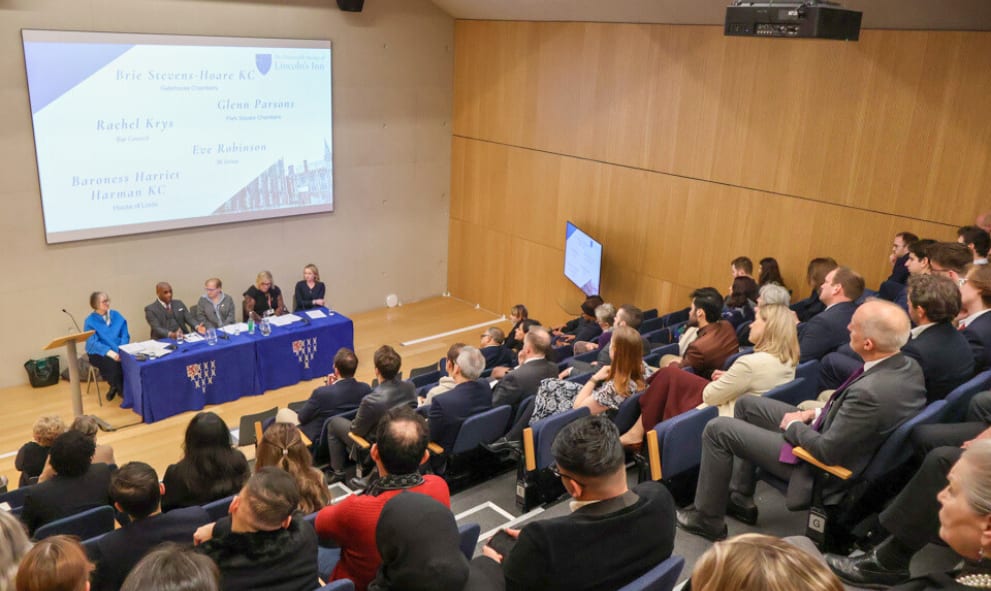
On 2 December 2025, Lincoln’s Inn hosted a panel discussion with Baroness Harriet Harman KC in response to her report on bullying, harassment, and sexual harassment at the Bar.
Baroness Harman outlined the report’s key findings and recommendations before joining a panel discussion chaired by Brie Stevens-Hoare KC (Gatehouse Chambers and Lincoln’s Inn EDI Committee). The panellists were Rachel Krys (Bar Council), Glenn Parsons (Park Square Barristers and Chair of the North Eastern Circuit Diversity Outreach Programme), and Eve Robinson (36 Group and report contributor).
The recording of Baroness Harman’s presentation and the panel discussion can be watched here:
Q&A themes
After the initial discussion, attendees both in-person and online were given the opportunity to put questions to the panel. This section of the event is not captured in the recording above. However, the Q&A underscored that meaningful cultural change requires both structural reforms and practical tools – stronger reporting mechanisms, clear standards, and proactive training. The desire to help create a safer, more respectful environment across the profession and for practical steps for cultural change and safeguarding professional standards was clear.
Themes and questions raised included:
- Commissioner for Conduct – Recruitment is underway. There was interest in understanding more about the Commissioner for Conduct’s role and how it will operate in practise. The Commissioner will provide practical advice and support for handling bullying and harassment cases, including reviewing investigatory reports and guiding next steps, but will not conduct investigations directly. Chambers should prepare to draw on the Commissioner’s guidance while continuing to build internal capacity for investigations. Clear protocols and trained personnel will remain essential.
- Bystander intervention as cultural change – There was discussion about active bystander training and how it might be delivered more widely. How can such training be scaled and normalised so that intervention becomes routine rather than exceptional? While current programmes include some bystander elements, standalone training remains rare. Effective intervention can range from direct confrontation to more subtle actions such as distraction or follow-up support. Training that covers this full spectrum helps individuals act safely and appropriately in different contexts. These interventions can significantly support victims, shift culture, and empower more people to respond when they witness concerning behaviour.
- Reporting barriers and rule reform – Current duty-to-report rules and the three-month reporting limit discourage victims and peers from seeking support. Recommendations include abolishing the time limit and creating explicit exemptions for victims and advisors.
- Clear standards on power imbalances – Attendees asked what safeguards exist for pupils and students. The report proposes making it misconduct for tenants to have sexual relationships with pupils, addressing power imbalances and protecting professional boundaries. Chambers and circuits should adopt clear misconduct policies and communicate them to all members, reinforcing that pupils are present for professional development, not subject to predatory behaviour. For those who are not part of chambers, such as students, concerns can still be reported to circuit leaders, Inns, and other relevant bodies. Any such behaviour should be reported immediately.
- Talk to Spot – the impact of anonymous reporting tools – Platforms like Talk to Spot have proven effective in aggregating informal complaints, enabling collective action at all levels of the profession. Aggregated reports help victims realise they are not alone and can prompt both formal and informal intervention. The panel stressed the importance of raising the profile of anonymous reporting tools and ensuring users understand how their information will be used. Rachel Krys emphasised: “On Talk to Spot, we never do anything without the person who’s made the complaint asking us to do it or giving us permission to do it. So we never take action on their behalf unless they ask us to. But when they ask us to, we do take action – and we’ve got quite a lot of soft power in that respect, but no actual formal power.”
- The waiver system and the duty-to-report – The waiver system allows individuals subject to the duty-to-report rule to seek an exemption where reporting could harm victims or breach confidentiality. A waiver can be granted to those who have received relevant training and are not responsible for managing reports of misconduct. The panel highlighted the need for clearer, updated guidance on how waivers work and how to apply for them. Chambers should ensure senior members and clerks understand when waivers can appropriately support victims while maintaining professional standards. They also noted that the forthcoming Conduct Commissioner role will address many related concerns, so waivers should not be the main focus at this stage. Updated guidance is expected soon. It may also be helpful to make the names of individuals with existing waivers available on each circuit so people know whom they can approach.
The event ended with a networking reception in the Ashworth Centre.